
Hanger Institute Announces Outcomes Data on 3D-Printed Cranial Remolding Orthoses

Abstract
Authors
Carroll, K.M.1, O’Shea, S.J.1, Fylstra, B.L.1, England, D.L.1, and Wurdeman, S.R.1
- Hanger Institute for Clinical Research and Education, Austin, Texas, United States of America.
Background
For clinicians managing moderate-to-severe positional plagiocephaly, cranial remolding orthoses (CROs) are a well-established intervention to help guide cranial growth and promote symmetry.1 As digital fabrication technologies (i.e., 3D printing) have entered routine orthotic practice, clinical decision making must increasingly consider how differences in fabrication method may influence treatment outcomes.
Traditional thermoformed CROs rely on manual fabrication processes that can introduce variability in fit and weight. In contrast, 3D printed CROs are produced using a fully digital workflow and may offer more precise, patient-specific fit, reduced weight, and greater ventilation. Although clinical adoption is increasing, comparative outcome data between 3D printed and thermoformed CROs remain limited.2,3
This study, originally submitted to the 52nd Academy Annual Meeting & Scientific Symposium, examines changes in the cranial vault asymmetry index (CVAI) among infants treated with 3D printed and traditional cranial remolding orthoses during routine clinical care.4
Methods
A retrospective matched cohort analysis was conducted using clinical data from 1,140 infants treated with FDA-cleared Class II cranial remolding orthoses as part of standard care. Of these, 228 infants received a 3D printed CRO (Sprout3D™) and were matched to 912 infants treated with traditional thermoformed CROs.
Each infant treated with a 3D printed CRO was matched with four infants treated with thermoformed CROs who had similar unadjusted age in months at treatment initiation, starting CVAI, cephalic index, sex, and time since treatment initiation.
Digital cranial scans were used to obtain initial and follow-up CVAI measurements. Because follow-up intervals varied as part of routine clinical practice, treatment duration was incorporated into the matching strategy. A linear mixed-effects model was used to compare follow-up CVAI outcomes between device types while accounting for the matched study design, individual patient variability, and variation in follow-up timing.
Results
Infants treated with the 3D printed CRO demonstrated a reduction in CVAI from a mean of 7.67% at treatment initiation to 4.38% at follow-up, corresponding to a 42.9% improvement. Infants treated with traditional thermoformed CROs improved from 7.63% to 5.17%, representing a 32.9% improvement.
After controlling for baseline severity, time since treatment duration, and other matched clinical factors, infants in the 3D printed cohort achieved significantly lower follow-up CVAI values than those treated with thermoformed CROs (p < 0.001), reflecting an approximately 10-percentage-point greater overall improvement in cranial asymmetry.
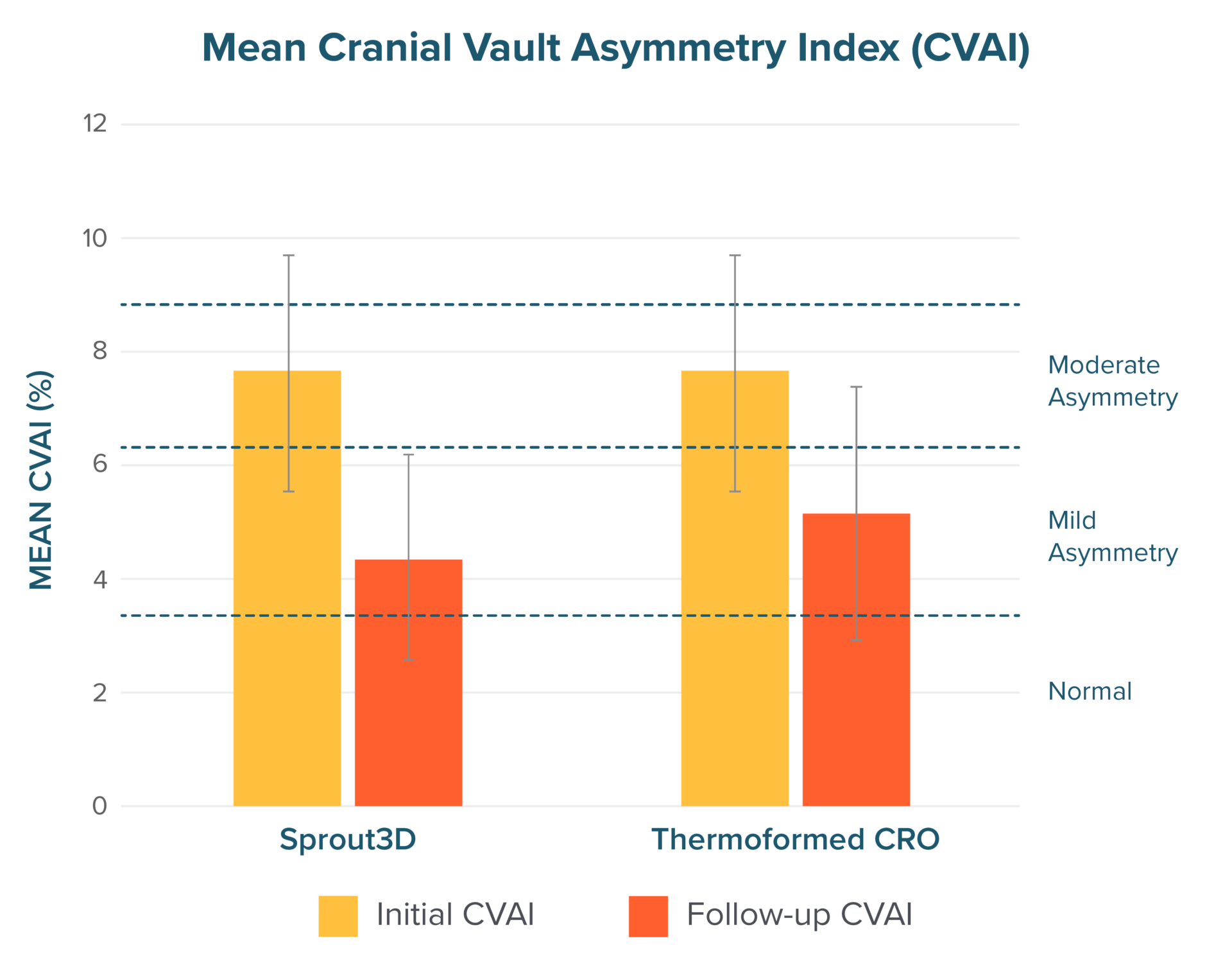
Figure 1
CVAI at initial evaluation compared to follow-up for infants treated with 3D printed (Sprout3D™) CROs compared to traditional thermoformed CROs. Severity of cranial asymmetry categorized according to the CHOA Plagiocephaly Severity Scale.5
Key Takeaways
- 3D printed cranial remolding orthoses produced 10-percentage-point greater improvement in CVAI than traditional thermoformed devices in a large matched clinical cohort.
- CRO selection should remain individualized, considering patient presentation, growth patterns, and caregiver factors alongside fabrication method.
Clinical Implications
In this large retrospective cohort study, infants treated with a 3D printed CRO (Sprout3D™) experienced greater improvements in cranial asymmetry than those treated with traditional thermoformed devices. Clinically, these findings may be explained by advantages of digital design and fabrication, including more precise patient-specific fit, reduced device weight, and increased ventilation, all of which may support comfort and adherence to the commonly prescribed 23-hour daily wear schedule. These findings align with emerging literature supporting the clinical performance of digitally manufactured orthoses.²˒³
Although wear-time adherence was not directly measured in this retrospective analysis, it remains an important factor in treatment success. Future investigations may further evaluate rate of correction and whether 3D printed CROs facilitate earlier achievement of treatment goals reducing the overall treatment duration and parent burden.
Based on the outcomes observed in this large clinical cohort, 3D printed CROs maintains strong clinical efficacy compared to traditional thermoformed CROs while offering practical advantages in fabrication reproducibility and overall patient experience.
Acknowledgements
The authors acknowledge Antonio Dias, for his contributions to data extraction and dataset preparation used in this study.
More Published Research
This publication is just one of the studies conducted by the Hanger Institute for Clinical Research and Education, in collaboration with leading researchers, clinical, and academic institutions.
References
1. Trebilcock, A. L., Findley, J. L., Cherry, J. S., Kasparek, J. A., Gordon, M. M., Beals, S. P., & Littlefield, T. R. (2025). A 10-Year Review of the Efficacy of Cranial Remolding Orthosis Treatment and Factors That Influence Outcomes for Infants with Isolated Deformational Plagiocephaly. Children, 12(8), 1099. https://doi.org/10.3390/children12081099 2. A, H., Naeem, R., Albeetar, R., Qufabz, T., AlFatafta, M., Alshawabka, A., Said, A. S., McGarry, A., Derkács, E., Varga, D., & Molics, B. (2025). 3D-printed cranial helmet therapy for the treatment of deformational plagiocephaly. Frontiers in Pediatrics, 13, Article 1638581. https://doi.org/10.3389/fped.2025.1638581 3. Graham, Tiffany MSPO; Wang, Jijia PhD. Efficacy of 3D-Printed Cranial Remolding Orthoses for Infants in Australia. Journal of Prosthetics and Orthotics 37(4):p 240-247, October 2025. | DOI: 10.1097/JPO.0000000000000550 4. Carroll, K. M., O’Shea, S. J., Fylstra, B. L., England, D. L., & Wurdeman, S. R. (2026). Comparison of CVAI correction between 3D printed and thermoplastic vacuum-formed cranial remolding orthoses [Abstract submitted for conference presentation]. 52nd Academy Annual Meeting & Scientific Symposium, American Academy of Orthotists & Prosthetists, Nashville, TN. 5. Children’s Healthcare of Atlanta. (n.d.). Plagiocephaly severity scale. Children’s Healthcare of Atlanta.

We are pleased to share new outcomes data from the Hanger Institute that adds to the growing evidence base supporting 3D-printed cranial remolding orthoses (CROs) as a treatment option. Read the full abstract.
Latest Updates
Subscribe to stay up-to-date on our latest posts.