AllPro™ XTS Demonstrates High Mobility Scores in Clinical Outcomes Analysis
Abstract
Building an Evidence Base for Prosthetic Foot Selection: Mobility Outcomes by HCPCS Category, Age, and Foot Model
Download Study Summary
Authors
Carroll, K.M.1, England, D.L.1, Remington, W.J.1and Wurdeman, S.R.1
- Hanger Institute for Clinical Research and Education, Austin, Texas, United States of America.
Background
For lower limb prosthesis users, mobility is closely linked to quality of life and satisfaction with care,¹ making prosthetic foot selection an important component of clinical decision-making. Prior research has shown that prosthetic foot type influences functional outcomes, including mobility, in individuals with amputation due to diabetes or vascular disease.² In practice, foot selection often begins with HCPCS classification. However, feet within the same L-code category can differ substantially in design features and mechanical performance,³ so the L-code alone may not fully reflect how a foot will perform for a given patient. Clinicians also have limited evidence on whether the mobility benefits of a foot category hold across patient ages, or how individual feet within the same category compare. To help inform these decisions, this study examined mobility outcomes across age groups for L5981 versus L5987/L5984 feet and compared mobility among five commonly used L5987/L5984 foot models. This work has been accepted for presentation at the American Academy of Orthotists & Prosthetists 2027 Academy Annual Meeting & Scientific Symposium, February 10–13, 2027.
Methods
This retrospective study analyzed data from private prosthetic clinics across the United States. Patients were categorized by prosthetic foot L-code (L5981 or L5987/L5984) and by age group (<35, 35–49, 50–64, and 65+ years). To compare individual feet within the L5987/L5984 category, a subset analysis examined users of five foot models: the Fillauer AllPro XTS, Proteor Rush Rogue 2, Ossur Pro-Flex XC Torsion, Proteor ShockWave, and WillowWood META Shock X. Mobility was measured using the Prosthetic Limb Users Survey of Mobility (PLUS-M), a patient-reported measure of mobility in which higher scores indicate better mobility.⁴ A two-way ANOVA assessed the effects of foot L-code and age group on PLUS-M scores, and a one-way ANOVA with Bonferroni correction compared mobility across the five foot models. Statistical significance was set at α = 0.05. The study was approved by Sterling IRB.
Results
The analysis included 11,348 patients. Most were male (77%), 60% had a below-knee amputation, and 44% had an amputation due to diabetes or vascular disease. Mobility declined with age in both foot categories. However, L5987/L5984 users (n = 1,479) had significantly higher mobility scores than L5981 users (p = 0.005; Figure 1). This difference was significant across all four age groups (<35, 35–49, 50–64, and 65+ years), with the largest difference among patients 65 and older, who scored an average of 4.21 points higher on the PLUS-M (p < 0.001).
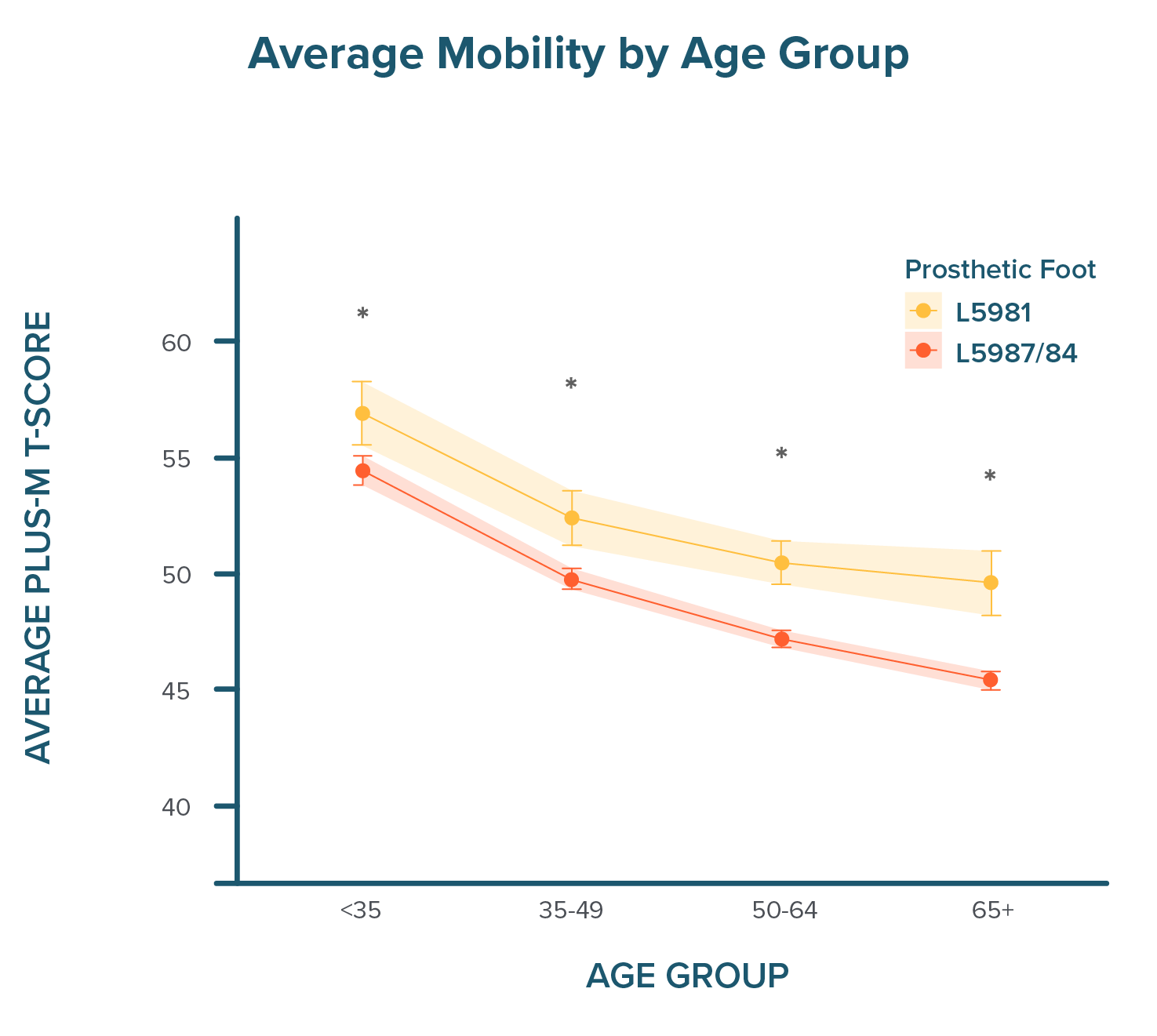
Figure 1. Average PLUS-M T-scores by age group for L5981 and L5987/L5984 prosthetic feet. Mobility declined with age for both groups, but L5987/L5984 users scored higher than L5981 users in every age group, with the largest difference among patients 65 and older.
Mobility also differed significantly among the five L5987/L5984 foot models (p < 0.001; Figure 2). Fillauer AllPro XTS users (n = 60) had the highest mean score (55.3 ± 11.3), significantly higher than users of the Proteor ShockWave (49.9 ± 10.8; n = 112), Ossur Pro-Flex XC Torsion (49.5 ± 10.6; n = 597), and WillowWood META Shock X (47.2 ± 9.9; n = 50). Proteor Rush Rogue 2 users (n = 660) had the second-highest mean score (52.0 ± 10.3), significantly higher than users of the Ossur Pro-Flex XC Torsion and WillowWood META Shock X.
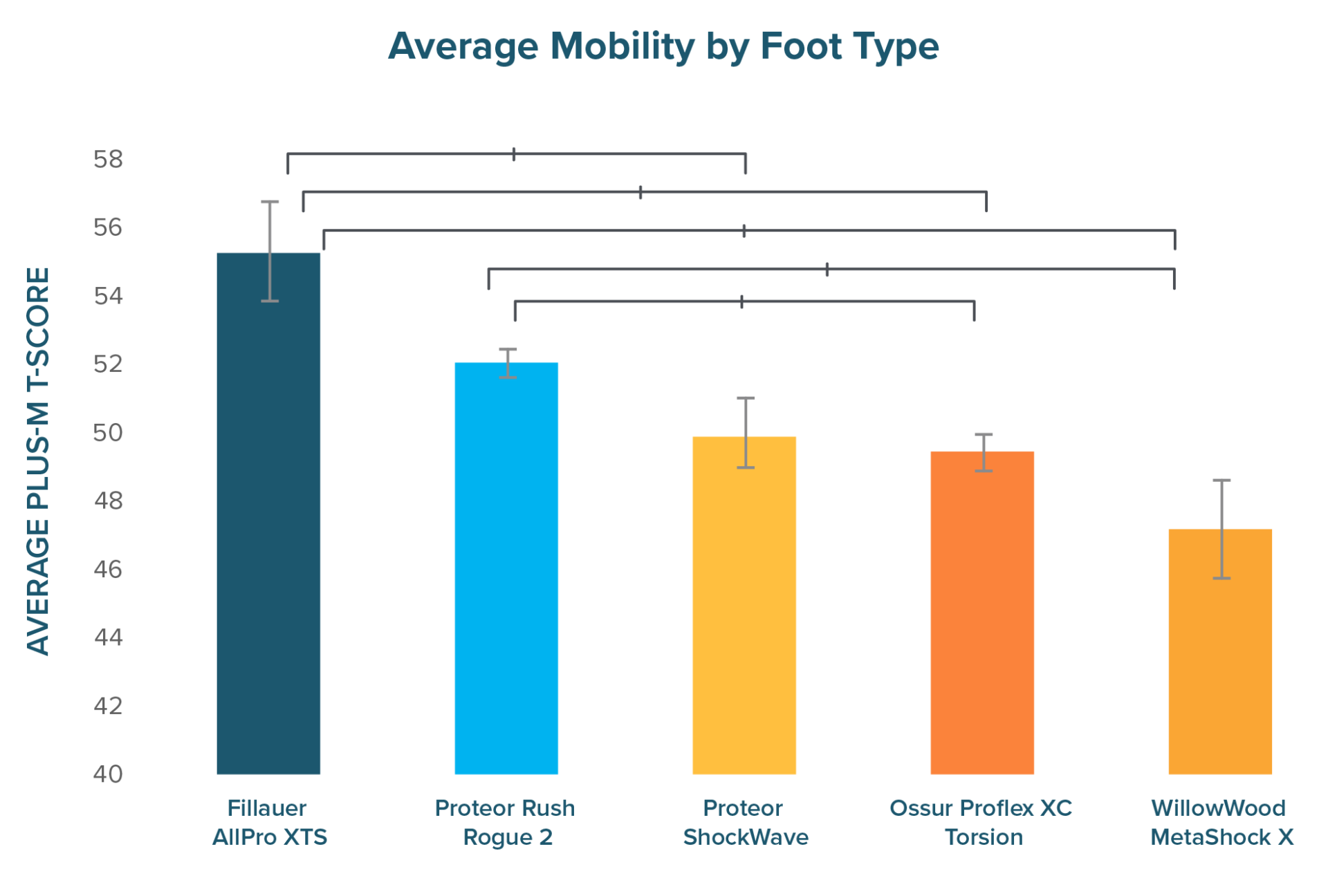
Figure 2. Average PLUS-M T-scores for five L5987/L5984 foot models. Fillauer AllPro XTS users had the highest mobility scores, followed by Proteor Rush Rogue 2 users. Brackets indicate significant differences between models (p < 0.05, Bonferroni-corrected). Error bars represent SE.
Key Takeaways
- L5987/L5984 feet were associated with higher mobility than L5981 feet in all four age groups (<35, 35–49, 50–64, and 65+).
- Mobility outcomes differed significantly among prosthetic feet within the same L-code category. Among five L5987/L5984 models, the Fillauer AllPro XTS and Proteor Rush Rogue 2 were associated with the highest mobility scores.
Clinical Implications
These findings give clinicians real-world evidence to guide prosthetic foot selection beyond HCPCS classification alone. L5987/L5984 feet were associated with higher mobility than L5981 feet across all age groups. The largest difference was among patients 65 and older, a population in whom preserving mobility is especially important. Mobility also differed among feet within the same L-code category, with the Fillauer AllPro XTS and Proteor Rush Rogue 2 associated with the highest scores. This suggests that device-specific design may influence outcomes. When selecting an L5987/L5984 foot, clinicians should consider foot-specific performance alongside build height, weight limits, and each patient’s activity demands.
Acknowledgements
We thank the clinicians whose dedication to collecting patient-reported outcomes made this research possible. Their ongoing support of our outcome initiatives continues to advance evidence-based prosthetic care for the patients we serve.
More Published Research
This publication is just one of the studies conducted by the Hanger Institute for Clinical Research and Education, in collaboration with leading researchers, clinical, and academic institutions.
References
1. Wurdeman SR, Stevens PM, Campbell JH. Prosthetics Orthotics Int. 2017;1-6. 2. Wurdeman SR, Stevens PM, Campbell JH. J Rehabil Assist Technol Eng. 2019;6:1-8. 3. Hofstad C, Linde H, Limbeek J, et al. Cochrane Database Syst Rev. 2004;1:CD003978. 4. Hafner B, Gaunaurd I, Morgan S, et al. Arch Phys Med Rehabil. 2017;98(2):277-285.
New research from the Hanger Institute for Clinical Research and Education examines mobility outcomes from more than 11,000 prosthesis users, comparing outcomes across HCPCS foot categories, patient age groups, and individual foot models.
Latest Updates
Subscribe to stay up-to-date on our latest posts.