The Hanger Institute for Clinical Research and Education Releases 2025-2026 Annual Report
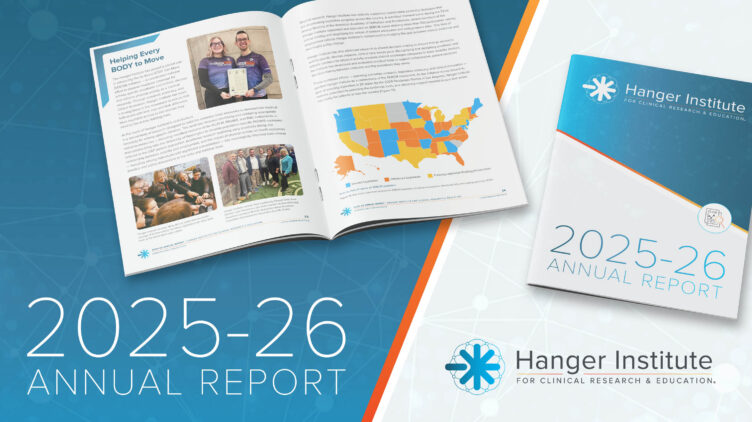
The Hanger Institute for Clinical Research and Education is pleased to release its 2025-2026 Annual Report documenting how rigorous research is being translated into real-world clinical improvements and highlighting major advancements in understanding patient outcomes, optimizing clinical decision-making, and shaping the future of access in O&P. Under the theme “Translate Data. Transform Practice. Improve Care,” the Institute has deepened its commitment to ensuring that evidence meaningfully improves patient outcomes.
Hanger Institute Annual Report
Review the progress the Hanger Institute for Clinical Research & Education has made to help improve clinical outcomes and provide evidence-based care.
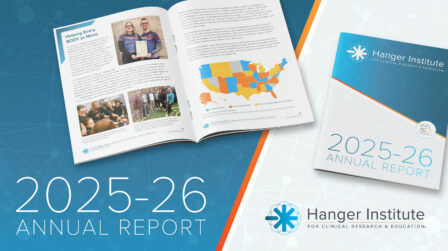
Through strategic collaboration, rigorous outcomes measurement, and a growing portfolio of peer‑reviewed work, the Institute continues to strengthen the evidence base that informs high‑quality O&P care. As Chief Clinical Officer Shane Wurdeman, PhD, FAAOP(D) notes in the report, the Institute’s mission extends beyond generating evidence; it is about ensuring that evidence meaningfully improves care for the individuals clinicians serve. This year’s report highlights major advancements in understanding patient outcomes, optimizing clinical decision-making, and shaping the future of access and equity in O&P.
Key Research Advances
Lower Limb Orthotic Care for a High Need Population: Conducted in partnership with the University of Washington, new research helps define the complex mobility, pain, and safety challenges experienced by lower limb orthosis users in the United States. These findings reinforce the importance of individualized orthotic care for a population that may otherwise face even greater limitations in function, independence, and quality of life.
Key takeaways included:
- Significant physical function deficits, with average PROMIS Physical Function scores in the 13th percentile among those living in the United States.
- High pain interference, averaging in the 74th percentile in the same population.
- Nearly 20% six‑month injurious fall rate, approximately 50% higher than rates observed among prosthesis users.
- Strong relationships between mobility, quality of life, satisfaction, and well‑being, reinforcing mobility as a central clinical construct.
The Institute also advanced the development and validation of the Orthotic Patient‑Reported Outcomes–Mobility (OPRO‑M) measure, now supported by peer‑reviewed evidence demonstrating strong construct validity and test‑retest reliability. This tool is poised to become a foundational instrument for assessing mobility among LLOU in both research and clinical practice.
Lower Limb Prosthetic Optimization: Research demonstrated significant improvements in mobility, satisfaction, quality of life, and participation following socket replacement, alignment refinement, and appropriate component selection.
- Socket and prosthesis replacement produced significant improvements in mobility, satisfaction, and quality of life across amputation levels.
- Alignment optimization was reinforced as a critical determinant of mobility, with structured diagnostic approaches helping clinicians resolve gait limitations that might otherwise be attributed to components or patient factors.
- Component selection research continued to challenge traditional prescribing patterns, showing that hydraulic ankle-foot components expand mobility potential in K2 ambulators and that microprocessor knee receipt within the first year post-amputation is associated with increased employment odds, particularly in underserved communities.
- The Institute also advanced tools such as mobility trajectory curves, the CASTLE 2 framework, and the Component Timed‑Up‑and‑Go (TUG) test, helping clinicians better interpret change and identify opportunities for intervention.
Bone-Anchored Prosthetics: The Institute contributed substantially to a State of the Science Conference, publishing practical guidance on biologically informed rehabilitation protocols, connector systems, and alignment considerations, as well as novel component prescription frameworks specific to osseointegrated systems.
Behind every data point in this report is an opportunity to better understand the people we serve and the care they deserve. By aligning research, shared decision-making, and advocacy, we are helping build a future in which orthotic and prosthetic care is more accessible, more personalized, and more responsive to individual goals.
Shane Wurdeman, PhD, FAAOP(D)Chief Clinical Officer
Strengthening the O&P Workforce
The Institute advanced a team-based care model integrating clinical extenders, demonstrating how properly trained clinical aides and certified assistants improve clinic efficiency while allowing clinicians to focus on high-impact clinical work and patient engagement.
The national O&P Residency Program, which has trained over 950 residents since 1996, underwent significant strategic restructuring to strengthen oversight and alignment with workforce needs, including a transition to a more centralized, coordinated training model, new resident and mentor advisory councils, and expanded mock board examinations and peer tutoring. The program now supports 150 NCOPE-approved sites and 395 approved mentors.
The Institute also collaborated on an AI platform purpose-built for O&P care that uses ambient listening and clinical documentation integration to reduce clinician burden while strengthening the patient-clinician relationship.
Collaborative Advocacy and Research
The Institute supported coordinated advocacy for the So Every BODY Can Move initiative, building the evidence base for activity-specific device coverage while advancing shared decision-making frameworks for clinical practice.
The Institute continued its long-standing collaboration with the Veterans Administration, yielding refinements to upper limb prosthesis measurement tools and launching the IM ABLE study, a multi-site investigation addressing critical gaps in ankle-foot orthosis research.
A Year of Impact
Throughout the year, Hanger Institute members presented at premier conferences, including ISPO World Congress, AOPA National Assembly, AAPM&R Annual Assembly, and 52nd Annual Meeting of the Academy. Fourteen peer-reviewed publications spanning bone-anchored prosthetics, lower limb orthotics and prosthetics, and upper limb prosthetics advanced the evidence base supporting clinical practice. By strengthening the evidence base, supporting clinicians, and advancing equitable access, the Institute continues to shape the future of orthotic and prosthetic practice.
About the Hanger Institute for Clinical Research and Education
The Hanger Institute for Clinical Research and Education is an assembly of experts and resources dedicated to advancing clinical practice and improving patient outcomes through leading-edge research, evidence-based care, and quality education.
More Published Research
Review additional studies conducted by the Hanger Institute for Clinical Research and Education, in collaboration with leading researchers, clinical, and academic institutions.
The Hanger Institute for Clinical Research and Education is pleased to release its 2025-2026 Annual Report documenting how rigorous research is being translated into real-world clinical improvements and highlighting major advancements in understanding patient outcomes, optimizing clinical decision-making, and shaping the future of access in O&P. Under the theme “Translate Data. Transform Practice. Improve Care,” the Institute has deepened its commitment to ensuring that evidence meaningfully improves patient outcomes.
Latest Updates
Subscribe to stay up-to-date on our latest posts.