Hanger Institute Research Shows Adjustable-Volume Prosthetic Sockets Significantly Improve Socket Comfort, Mobility, and Quality of Life
Abstract
Physical Medicine and Rehabilitation Journal
Authors
Dwiesha England, MS1, Phil Stevens, PhD, CPO1, Aolani Wheeler, BS1, Bretta Fylstra, PhD1, Kathleen Caroll, MS, MSPO, CPO1, Emily Steffensen, PhD, MSPO, CPO1,2, Todd Castleberry, PhD1, Shane Wurdeman, PhD, CP1
- Hanger Institute for Clinical Research and Education, Austin, Texas, United States of America.
- Hanger Clinic, Omaha, NE, United States.
Background
The prosthetic socket is fundamental to successful lower-limb prosthetic fitting and directly influences patient comfort and functional outcomes. Fixed-geometry sockets remain the clinical standard, yet they cannot accommodate residual limb volume fluctuations that occur from daily activity, tissue remodeling, or progressive atrophy. This limitation often necessitates frequent sock adjustments and compromises fit consistency, comfort, and functional performance.
Adjustable-volume sockets (AVS) have seen increasing clinical adoption in recent years, yet evidence supporting their efficacy has been limited to case reports and small cohort studies. A new Hanger Institute analysis of 444 adults transitioning from fixed-geometry sockets to AVS provides the largest longitudinal real-world outcome data set to date.
Objective
To evaluate the impact of AVS on socket comfort, quality of life, general satisfaction, satisfaction with walking ability, and prosthetic mobility in a large clinical population during the first 12 months after AVS receipt.
Design
Researchers conducted a retrospective cohort study across multiple U.S. prosthetic clinics, capturing data from 2023 to 2025. Participants (n = 444) with lower-limb amputation transitioning from fixed-geometry to AVS sockets completed baseline assessments within 1 year pre-receipt and follow-up assessments 8 days to 1 year post-receipt. Mean age 55.7 years; 59.7% below knee (BK), 40.3% above knee (AK), with primary amputation etiology being vascular/diabetes (57.2%).
Results
Primary Outcome: Socket Comfort
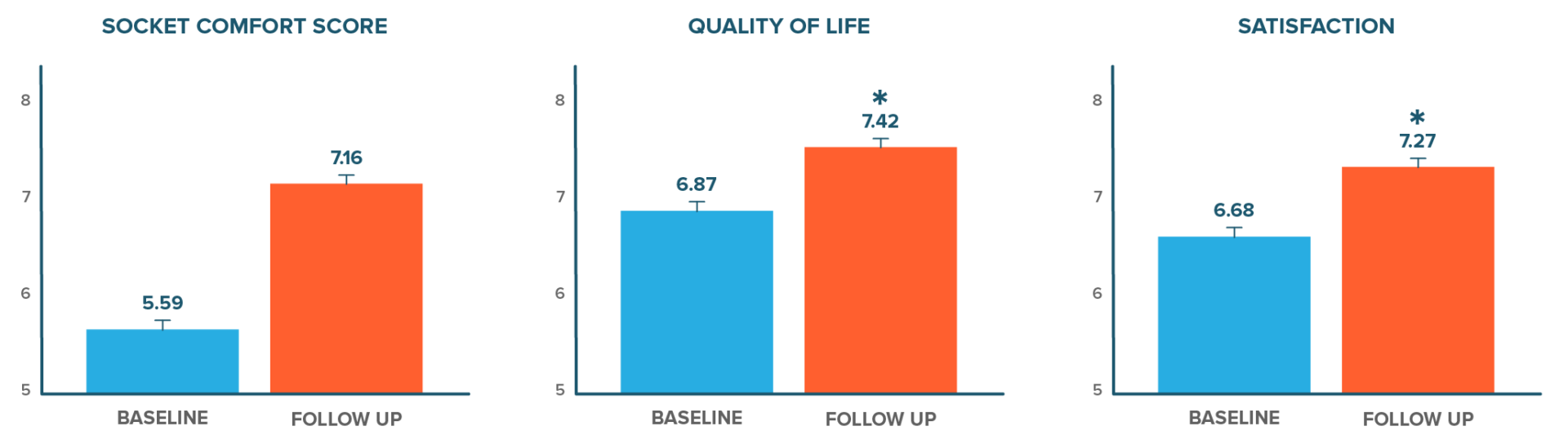
Participants reported significant improvement in socket comfort following AVS transition. Mean Socket Comfort Score (SCS) increased from 5.59 to 7.16 on an 10-point scale (p < .001), with a moderate effect size (Cohen’s d = .64). Among above-knee users, SCS rose from 5.42 to 7.10; below-knee users improved from 5.69 to 7.20, demonstrating consistent benefit across amputation level.
Secondary Outcomes: Functional Gains Across the Board
Mobility, quality of life, general satisfaction, and walking-related satisfaction all improved significantly.
- Prosthetic mobility (PLUS-M T-score): 44.8 → 46.9 (p < .001)
- Quality of life (PEQ Well-Being subsection): 6.87 → 7.42 (p < .001)
- General satisfaction: 6.68 → 7.27 (p < .001)
- Satisfaction with walking ability: 5.68 → 6.66 (p < .001)
Improvements in Socket Comfort were not isolated outcomes. Change-score correlations showed that greater comfort gains correlated with longer daily prosthesis wear, higher mobility scores, and stronger overall satisfaction. Specifically, improvements in SCS were moderately to strongly associated with increases in quality of life and general satisfaction.
Conclusion
- AVS demonstrates significant and clinically meaningful improvements in socket comfort (2-point gain on SCS) across both AK and BK populations.
- Comfort improvements correlate strongly with functional gains in mobility, quality of life, and satisfaction with walking ability.
- Greater comfort gains are associated with longer daily prosthesis wear time, suggesting improved tolerance and functional adoption.
More Published Research
This publication is just one of the studies conducted by the Hanger Institute for Clinical Research and Education, in collaboration with leading researchers, clinical, and academic institutions.
Hanger Institute for Clinical Research and Education announced the publication of a new study, Longitudinal improvements in comfort, mobility, and quality of life with adjustable-volume prosthetic sockets, in the journal Physical Medicine and Rehabilitation (PM&R). The results of the study demonstrated that adjustable-volume prosthetic sockets (AVS) are associated with clinically meaningful improvements in socket comfort and overall quality of life for lower-limb prosthetic users. Read the clinical study summary.
Latest Updates
Subscribe to stay up-to-date on our latest posts.